Somebody needed exactly what you sell this morning. They did not call around, ask a neighbor, or flip open a directory. They picked up a phone, typed a half-sentence into a search box or an AI assistant, and chose from whatever came back in the next forty seconds.
You were either in that forty seconds or you were not. That is the whole reason digital marketing exists as a discipline — and it is also why the term has collected so much jargon that plenty of business owners have quietly stopped asking what it means.
So here is the plain version. What it is, what each piece actually does, which pieces are worth your money first, and how to tell whether any of it is working. No acronym soup.
What Is Digital Marketing?
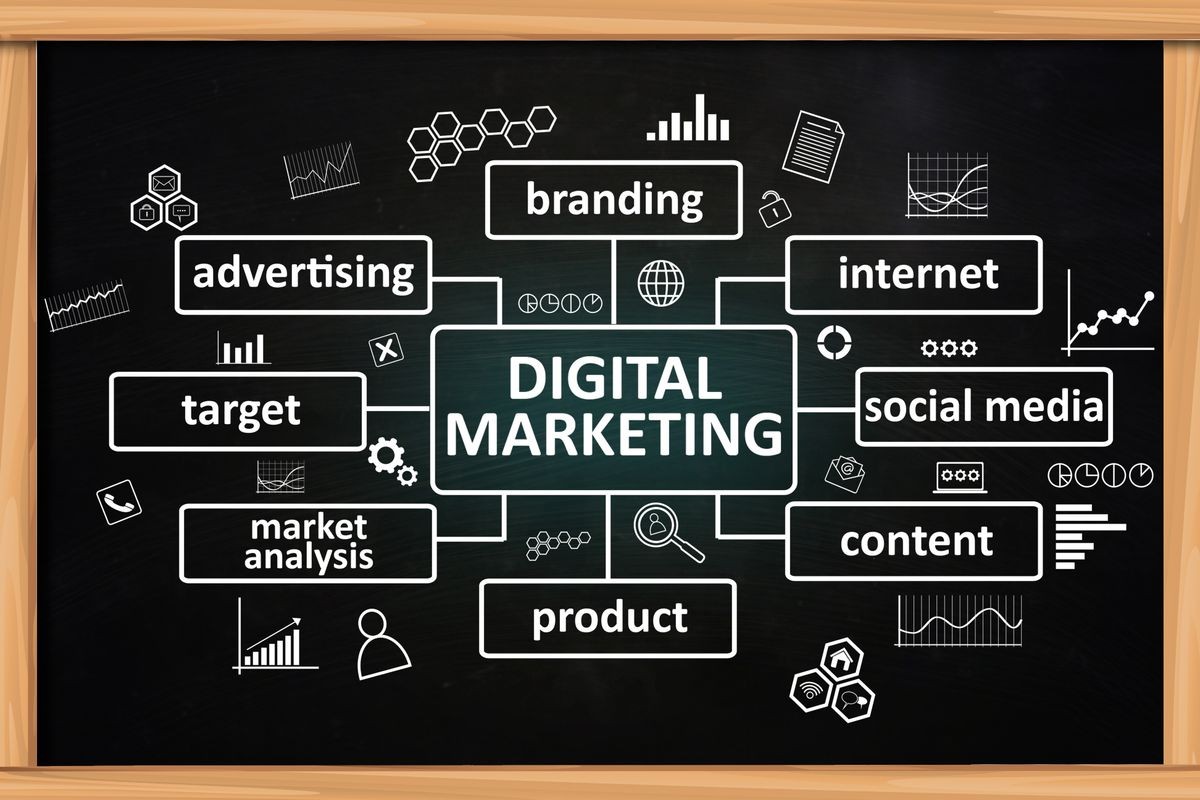
Digital marketing is any effort to reach, persuade, and keep customers through internet-connected channels — search engines, your own website, email, social media, video, messaging apps, and online advertising. If a person can encounter your business through a screen, the work of shaping that encounter is digital marketing.
That definition is broad on purpose, because the category is broad. A dentist correcting their opening hours on Google Maps is doing digital marketing. So is a software company running a six-figure paid search program. The scale differs enormously; the underlying job does not.
And the job is narrower than most people assume. It is not “being online.” It is making sure that at the specific moment a person is deciding, your business is present, understandable, and credible enough to be chosen.
How it differs from traditional marketing
Traditional marketing — print, radio, billboards, direct mail — mostly interrupts. You rent attention from an audience that was doing something else, and you hope enough of them happen to need you. It works, but it is expensive to target and famously hard to attribute.
Digital marketing changes three things. You can reach people at the moment they are actively looking rather than merely present. You can target narrowly enough to stop paying for people who will never buy. And you can usually trace a customer from first click to closed sale, which means you can stop doing the things that do not work.
Why It Matters More Than It Did Five Years Ago
Two shifts have raised the stakes, and they compound each other.
The first is that discovery moved to the phone. Not “also happens on the phone” — moved. The average decision about a local service now starts and often ends on a handset, in a session measured in seconds, on a screen that shows three or four options before anyone scrolls.
The second is that the results page itself changed. Search engines and AI assistants increasingly answer the question directly instead of handing over ten links. If your business is not one of the sources behind that answer, you are not in a lower position — you are absent. We went deeper on that shift in our look at what is changing in 2026.
Put those together: fewer visible slots, decided faster, on a smaller screen. The margin for being hard to find has shrunk.
The Channels, and What Each One Is Actually For
This is where most guides lose people — a long list of channels described in identical enthusiastic language, as if you should be doing all of them. You should not. Each channel answers a different customer at a different moment, and knowing which moment is the whole skill.
Search engine optimization (SEO)
SEO is the work of making your site the answer a search engine is willing to serve. It has three unglamorous halves — technical (can the page be crawled, does it load, does it work on a phone), content (does it genuinely answer the question better than the alternatives), and authority (do credible sites and sources point at you).
It is slow. It is also the only channel where the asset you build keeps working after you stop paying for it. A page that ranks well earns visits every month for years, which is why the cost per lead from search tends to fall over time while paid channels stay flat or climb. That compounding is the entire argument for it, and it is the core of our search & AI visibility work.
Content marketing
Content marketing is publishing things that are useful whether or not the reader buys today — guides, comparisons, case studies, calculators, honest teardowns of how the work actually gets done. SEO is the distribution; content is the substance. Neither survives long without the other.
The failure mode is volume for its own sake. Ten thin posts covering what everyone else already covered will do less than one page that answers a real question with information only you have — your pricing logic, your failure rates, what you learned on a job that went sideways. Specificity is the differentiator, and it happens to be the thing competitors cannot copy.
Local and maps visibility
For any business with a service area or a front door, this is usually the highest-return channel and the most neglected. The map pack — those three listings above the normal results — takes a disproportionate share of clicks for anything with local intent, and the inputs are unglamorous: an accurate, complete business profile, consistent name-address-phone details across the web, real photos, and a steady flow of recent reviews.
None of that is technically hard. It is just fiddly and easy to let drift, which is exactly why doing it properly still separates businesses. The details are in local & maps visibility.
Paid search and paid social (PPC)
Paid search puts you in front of people already typing the problem. Paid social puts you in front of people who match your customer profile but were not looking. Both are billed per click or per impression, both stop the instant you stop paying, and they behave differently enough that treating them as one budget line is a common and expensive mistake. Our breakdown of what digital marketing costs keeps ad spend and management fees on separate lines for the same reason.
The honest case for paid: it is the fastest way to find out whether your offer, your landing page, and your follow-up actually convert. You can learn in six weeks what SEO would take six months to teach you. Several of our best organic campaigns started life as a paid test that told us which message to build the content around.
Email and SMS
The least fashionable channel and, per dollar spent, routinely the most profitable. The reason is structural rather than clever: you own the list. No algorithm change, no bidding war, no platform deciding to start charging you for reach it used to give away.
It is also where most businesses leave the clearest money on the table. Every inquiry that did not close, every past customer, every person who downloaded something and went quiet — those are people who already raised a hand. A basic sequence that follows up properly frequently outperforms an entirely new acquisition campaign.
Social media
Social is best understood as two different jobs sharing a login. One is distribution — getting a piece of work in front of people. The other is proof — the check a prospect runs after they have already heard of you, to see whether you look like a real, active business.
For most B2B and considered-purchase businesses, the second job is worth far more than the first, and it is much cheaper to do well. A profile that shows recent work, real faces, and evidence you exist beats a posting schedule nobody reads.
Video
Short-form video has become the first place a lot of customers meet a business at all. The instinct is to make something polished; what actually works is closer to the opposite — a before-and-after, two minutes on the thing customers always get wrong, a walkthrough of work in progress.
Video is also the fastest route to trust for anything where a customer is nervous — clinical work, anything happening in their home, anything expensive. Seeing the person is worth more than reading about them.
Marketing automation
Automation is the plumbing: the follow-up that fires when a form is submitted, the reminder before an appointment, the review request three days after the job is done, the lead routing that makes sure an inquiry reaches a human before it goes cold.
It generates no demand on its own. What it does is stop you losing demand you have already paid for — which, for most businesses we audit, is a bigger number than anything a new campaign would add. That is the premise behind our lead & booking systems.
Affiliate, influencer, and partner marketing
All three are versions of the same idea: borrowing someone else’s audience and paying for the privilege, either per sale or per campaign. Affiliates take a cut of revenue. Influencers take a fee for access to attention they have built. Partners trade audiences with you.
The reliable pattern is that smaller, narrower audiences outperform large ones. Someone with a few thousand genuinely relevant followers usually converts better than someone with a hundred thousand mixed ones — and costs a fraction as much.
Digital PR
Getting written about by publications, industry sites, and podcasts your customers already trust. It does two jobs at once: the direct audience, and the credible links and mentions that make search engines and AI systems more willing to treat you as a legitimate source. Slow, unpredictable, and disproportionately valuable when it lands.
Choosing between them
| Channel | Time to results | Stops when you stop paying? | Strongest for |
|---|---|---|---|
| SEO & content | 3–6 months | No — compounds | Repeatable demand, long buying cycles |
| Local & maps | 4–8 weeks | No — compounds | Service areas, front doors, “near me” intent |
| Paid search | Days | Yes | Urgent needs, fast testing, proven offers |
| Paid social | 2–6 weeks | Yes | Demand you have to create, visual products |
| Email & SMS | Immediate on an existing list | No — you own it | Repeat business, unconverted inquiries |
| Social & video | 2–3 months | Partly | Trust, proof, first-time discovery |
| Digital PR | Unpredictable | No | Authority, links, credibility |
B2B and B2C Are Not the Same Game
The channels overlap; the strategy does not. It is worth being explicit about why, because a lot of generic advice quietly assumes one and then gets applied to the other.
- Number of decision-makers. A consumer decides alone, often in one sitting. A business purchase typically involves several people, some of whom you will never speak to. Your content has to be forwardable — it needs to make the case to someone who was not on the call.
- Timeline. Consumer decisions run from seconds to days. B2B runs from weeks to quarters, which means the job is staying credibly present across a long gap rather than winning a single moment.
- What persuades. Consumers respond to how a purchase will feel. Business buyers respond to risk reduction — the case study, the reference, the sense that nobody gets blamed for choosing you.
- Where they are. B2C skews to search, social, and video. B2B skews to search, email, industry publications, and professional networks — and email stays far more central to B2B than most people expect.
How the Pieces Fit Together
Channels are not a menu you pick from at random. They map to stages a customer moves through, and a campaign underperforms very often because it is aimed at the wrong stage.
Awareness — they have a problem, not a shortlist
The person knows something is wrong but does not yet know what the solution is called. They are searching in symptoms, not product names. Content that explains, video, social, and digital PR do the work here. Asking for the sale at this stage is the most common way to waste a good ad budget.
Consideration — they are comparing
Now they know what they need and are weighing options, including doing nothing. This is where comparisons, case studies, pricing transparency, and reviews earn their keep. Our case studies exist for exactly this moment — not to impress, but to let someone check whether we have solved their specific problem before.
Decision — they are looking for a reason to say yes or no
The remaining friction is practical: is it easy to get in touch, does anyone reply quickly, is the price knowable, does the booking form work on a phone. Paid search on high-intent terms, a clean landing page, obvious contact details, fast follow-up. Most deals lost at this stage are lost to friction, not to a competitor.
What a Digital Marketer Actually Does
The job title covers wildly different work depending on the size of the business, which is part of why it is hard to hire for. In practice the week splits four ways.
- Deciding what to do next. Reading what happened last month, working out which channel is under-served, and choosing where the next unit of budget or effort goes. This is the part that actually determines the outcome.
- Making the things. Pages, ads, emails, videos, landing pages — the assets themselves, or the briefs and review that get them made properly by someone else.
- Running the systems. Campaign management, budget pacing, list hygiene, automation that breaks quietly, tracking that stops firing after a site update.
- Proving it worked. Attribution, reporting, and the harder conversation about which numbers matter. A marketer who cannot connect activity to revenue is producing activity.
In a small business, one person does all four badly because there are not enough hours in the week. That is usually the point where a specialist or an agency starts to make sense — not because the work is mysterious, but because the fourth item never gets done.
A Realistic First 90 Days
If you are starting more or less from scratch, resist the urge to launch everything at once. This sequence works because each step makes the next one cheaper.
- Weeks 1–2: fix measurement. Analytics installed and correct, conversions defined as things that actually matter (a booked call, not a page view), call tracking if the phone is how you get business. Everything after this is guesswork without it.
- Weeks 2–4: fix the destination. Make sure the site loads fast on a phone, says clearly what you do and where, and has one obvious next step on every page. There is no point buying traffic for a page that cannot convert it.
- Weeks 3–5: claim the free ground. Business profile completed properly, details consistent everywhere, and a process for asking every satisfied customer for a review. Cheapest reliable return in the whole discipline.
- Weeks 4–8: buy some certainty. A small, tightly targeted paid campaign on your highest-intent terms. The goal is not profit yet — it is finding out which message, which offer, and which audience convert.
- Weeks 6–12: build the compounding asset. Take what the paid test taught you and turn it into content and pages aimed at the same intent. Now you are building something that keeps earning after the campaign stops.
- Throughout: close the loop. An automated follow-up on every inquiry, and a re-engagement sequence for anyone who went quiet. This is where the leads you already paid for stop leaking.
Where AI Actually Fits
AI has changed digital marketing in two directions at once, and they are worth separating because they call for opposite responses.
On the production side, it has collapsed the cost of making things — drafts, ad variations, segmentation, summarizing a quarter of data. Used well, it removes the busywork that used to eat a strategist’s week. Used badly, it produces enormous quantities of content that says nothing, which is now abundant enough that not publishing it has become a competitive advantage.
On the discovery side, it has changed how customers find you at all. When an assistant answers a question directly, the businesses it cites are the ones with clear, specific, verifiably credible content — which, conveniently, is the same content that persuades humans. The technique changes; the underlying requirement does not.
The Honest Downsides
Any guide that only lists benefits is selling something. Four real costs, so you can plan for them.
- It gets more expensive every year. Paid channels are auctions, and auctions with more bidders cost more. A cost per lead that worked two years ago may not work now, and the fix is usually conversion rate rather than budget.
- The ground moves under you. Search results, platform algorithms, and privacy rules change without notice. Anything built entirely on a channel you do not own is a tenancy, not an asset.
- Attribution is genuinely hard. Real customers touch six or eight things before buying, and privacy protections have made the tracking blurrier. Anyone promising perfect attribution is either mistaken or selling.
- It rewards patience you may not have. The channels with the best long-run economics are the slowest to start. The temptation is to keep restarting the fast ones instead, which is how businesses spend three years permanently in month one.
How to Tell If It Is Working
Most marketing reports are a wall of numbers that carefully avoid the only question that matters. Four figures tell you almost everything.
- Cost per acquired customer — not per click, not per lead. What did it cost to get someone who actually paid you?
- Lead-to-customer rate by channel. Two channels producing identical lead volumes routinely differ threefold in how many become customers. Averaging them hides the one worth doubling.
- What a customer is worth over their lifetime. Without this you cannot tell whether a cost per acquisition is good or catastrophic, and you will keep switching off campaigns that were quietly profitable.
- The share of business you can explain. If you cannot account for where most of last month’s customers came from, measurement is the priority — not marketing.
The point is not to have more marketing. It is to know which parts you could stop doing tomorrow without losing a single customer.
Where to Start
If you take one thing from all of this: you almost certainly do not need more channels. Most of the businesses we talk to are already doing six things adequately and would do better with three done properly and measured honestly.
Start with the free ground you have not claimed, fix the page people land on, and get measurement working before you spend anything on traffic. That order is boring, and that is exactly why it works.
If you would rather have someone map that out against your actual numbers than guess at it, a growth audit is where we usually start — or just tell us what is not working and we will tell you honestly whether we are the right people to fix it.
Frequently asked
What is digital marketing in simple terms?
Digital marketing is any effort to reach and persuade customers through internet-connected channels — search engines, websites, email, social media, video, messaging apps, and online ads. It covers everything from a Google Business Profile listing to a paid search campaign.
What are the main types of digital marketing?
The core types are search engine optimization, content marketing, local and maps visibility, paid search and paid social advertising, email and SMS marketing, social media marketing, video, marketing automation, affiliate and influencer partnerships, and digital PR.
How is digital marketing different from traditional marketing?
Traditional marketing interrupts an audience you rent by the impression — print, radio, billboards — and is hard to attribute. Digital marketing can reach people at the moment they are actively looking, can be targeted narrowly, and can usually be traced from first click to closed sale.
How long does digital marketing take to show results?
Paid advertising can generate leads within days, though it usually takes four to eight weeks of spend to learn what converts. SEO, content, and reputation work typically take three to six months to move meaningfully, and keep compounding after that.
What is a realistic digital marketing budget for a small business?
There is no universal minimum. A practical starting point is to fix your target cost per acquired customer, then budget enough to buy a useful number of conversions at that price — usually at least 30 to 50 a month before the data tells you anything reliable.
Do I need every digital marketing channel?
No. Most small and mid-sized businesses get better results from two or three channels run properly than from eight run thinly. Start where your customers already are and where buying intent is highest, then expand once a channel is consistently profitable.
Sources
- Digital marketing
- SEO
- Paid media
- Email marketing
- Content marketing
- Marketing strategy
Velvo Content Team
Growth & Engineering